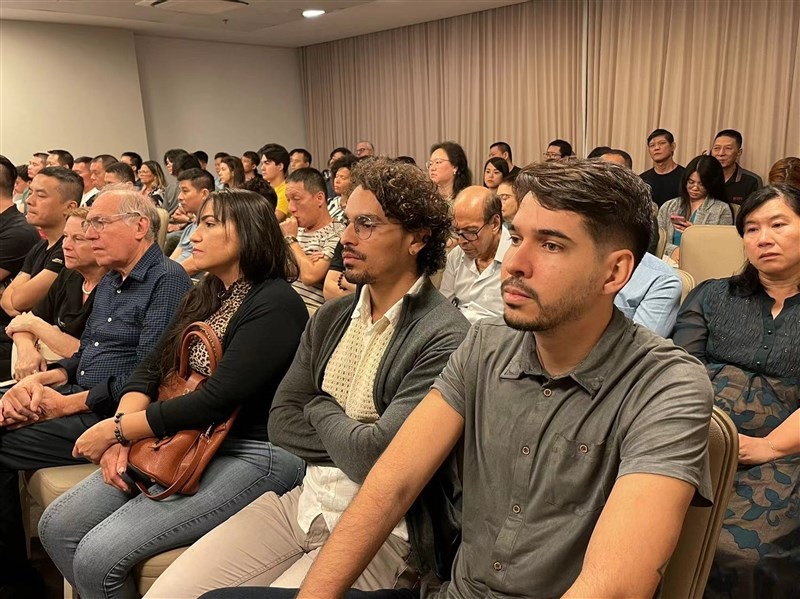
 A lot of young adults attend the Buddhist Lecture by Most Venerable Hsin Bao. photo/The Merit Times
Albert Lin, The Merit Times staff writer
July 6, 2023
Temple Budista Fo Guang Shan-Recife is located on the northeastern coast of Brazil and is the only Buddhist temple in the area. It was completed in 2002 and has been propagating Buddhism for 21 years. On July 5th, Most Venerable Hsin Bao, Abbot of Fo Guang Shan, visited Temple Budista Fo Guang Shan-Recife and conducted two sessions of Heart-to-Heart Connection and a lecture on Buddhism. The translation into Portuguese was done by Venerable Miao You, Abbess of I.B.P.S. Do Brasil. Over 400 people attended the event, with half of them being Brazilians, making it a remarkable success.
 Temple Budista Fo Guang Shan-Recife is located on the northeastern coast of Brazil and is the only Buddhist temple in the area. photo/The Merit Times
In the afternoon of July 5th, Most Venerable Hsin Bao conducted a heart-to-heart connection session with the devotees at Temple Budista Fo Guang Shan-Recife. Six Brazilian devotees raised Buddhist questions for consultation.
 Most Venerable Hsin Bao visited Temple Budista Fo Guang Shan-Recife to give a Buddhist lecture. photo/The Merit Times
●Antonio from Brazil: The Diamond Sutra mentions "Even the Dharma should be cast aside," but the Dharma is good, so why should it be cast aside?
●Most Venerable Hsin Bao: The original scripture mentioned in the Diamond Sutra is "Even the Dharma should be cast aside; how much more so the Not-Dharma?" The scripture of the Diamond Sutra uses the metaphor of a raft. It means that when you need to cross a river, you must use a raft, but once you have crossed the river, you do not need to carry the raft with you. It should be cast aside.
In terms of "good and evil," we should do good deeds. However, if we seek true perfection, we need to learn from the Sixth Patriarch Huineng's teaching in Zen Buddhism, which is "neither thinking of good nor thinking of evil." This is because concepts of good and evil, right and wrong, involve discrimination. There is no inherent good or evil at the origin and starting point of Dharma.
The Diamond Sutra contains a scripture passage that discusses the cultivation of good deeds: "The practice of all good virtues (Dharmas), free from attachment to an ego, a personality, a being and a life, will result in the attainment of Supreme Enlightenment." Even when performing acts of goodness in the world, we must let go of the notion of a self who is engaged in doing good in order to attain true perfection.
●Wang Yu from Mainland China: The Dharma mentions "dependent origination." How do we know the causes and effects of dependent origination?
●Most Venerable Hsin Bao: When we are hungry, eating makes us feel full; when it's cold, wearing clothes keeps us warm; when we are sick, taking medicine helps us recover. Therefore, by understanding the correct causes and doing the right things, we can achieve good results.
The same principle applies to cultivation! We can set goals and anticipate the outcomes, and then review how many correct seed we sow. If we have a clear vision of our goals in 10, 20, and 30 years, we will achieve success.
After receiving the ryakarana from the Dipamkar, Shakyamuni Buddha pondered for a long time and discovered six correct cultivation practices: generosity, upholding precepts, patience, diligence, meditation, and wisdom—known as the Six Perfections. By following these methods life after life, one can quickly become Buddha. By finding the correct causes and using the right methods, good results will follow.
 Most Venerable Hsin Bao delivered a talk titled "Inspiration from Stories on Buddhism" at the conference hall of LUZEIROS HOTEIS. photo/The Merit Times
●Emeline from Brazil: Is the Pure Land of Ultimate Bliss a real place or just an idea?
●Most Venerable Hsin Bao: Both are true.
What is the Pure Land of the mind? It is when your mind is free from afflictions, greed, hatred, and ignorance, and you are at ease and happy.
As long as there are no afflictions in your mind, any place can be a Pure Land. Once you achieve this, it doesn't matter whether you go to the Pure Land or not.
If you want to go to the world of Ultimate Bliss, you need to understand what is the Pure Land that Amitabha Buddha has created. Going to the Pure Land is special and perfect, but even after you arrive there, you still need to cultivate. It is not a place for mere enjoyment.
●Talita from Brazil: After the passing of Venerable Master Hsing Yun, you (Most Venerable Hsin Bao) take on the mission of propagating Buddhism at Fo Guang Shan, what does it feel like?
●Most Venerable Hsin Bao: We must have a sense of mission to ensure the enduring propagation of Buddhism. If Buddhism thrives, more people will come onto the virtuous path; if Buddhism declines, many people will fall into the evil path.
Many people in the world pass through their lives in a state of confusion and unawareness. This is not only regrettable but also uncertain when they will have the opportunity to learn the Dharma. Each person should seize the opportunity because in the Six Realms of Existence, having a human life is extremely rare!
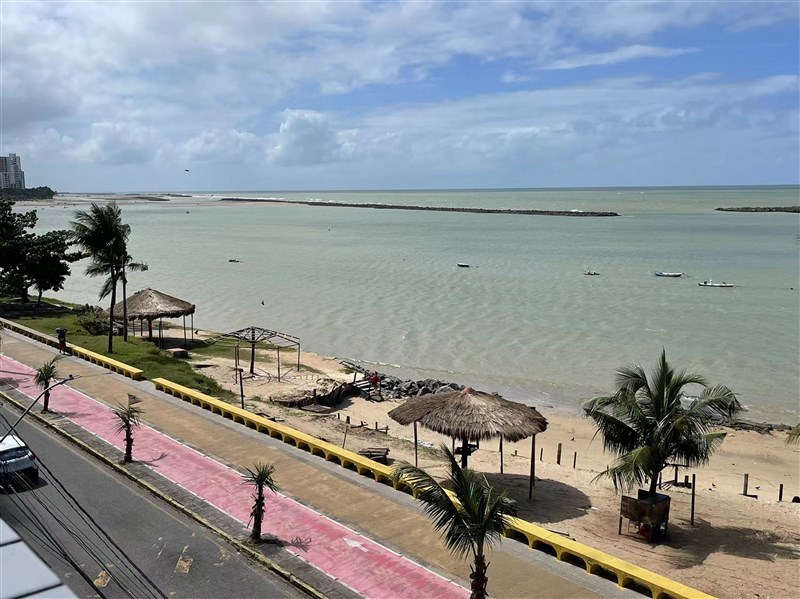 Temple Budista Fo Guang Shan-Recife is located by the coast, facing the vast ocean and is a precious place for learning Buddhism. photo/The Merit Times
●Edvaldo from Brazil: Does the "Middle Way" mentioned in Buddhism refers to a state that is between ignorance and enlightenment?
●Most Venerable Hsin Bao::There two different worlds: the world of ignorance and the world of enlightenment. That is because some people understand the causes and effects, and some don't; some understand the generosity and some don't; some understand the patience and some don't; some understand the meditation and some don't.
Some people are fascinated by the changing scenery of the four seasons, and they live in the world of ignorance. Others are able to see the truth of impermanence through the changes of the four seasons, and they live in the world of enlightenment.
●Mo Ji Song, an ethnic Chinese: The purpose of learning Buddhism is to become a Buddha. What happens after becoming a Buddha? And what is a Buddha?
●Most Venerable Hsin Bao: Regarding this question, it is important to first understand what "Avalokitesvara Bodhisattva" is. According to the "Sixth Patriarch's Platform Sutra," "compassion is Avalokitesvara Bodhisattva." When we engage in compassionate actions, we become Avalokitesvara Bodhisattva.
As for what is Buddha? The "Diamond Sutra" says, "Dharma is universal and impartial." When you treat every person equally, you are Buddha.
Venerable Master Hsing Yun also said, "I am Buddha," referring to taking responsibility in any situation.
 Six Fo Guang members, including (from left)Mo Ji Song, Antonio, Wang Yu, Talita, Emeline, Edvaldo, raised Buddhist questions. photo/The Merit Times
There were several honored guests in attendance, including Venerable Hui Dong, the Abbot of Hsi Lai Temple. Wu Mingwei, President of Buddha's Light International Association (BLIA) Brazil Recife Subchapter; Lu Gongrong, Vice President of BLIA Brazil Recife Subchapter and president of the Recife Overseas Chinese Association; Wu Qing, Chief Supervisor of Recife Overseas Chinese Association; Chen Zhong, President of China-Brazil Foreign Trade and Business Association; Lin Wentan, Chief Supervisor of China-Brazil Foreign Trade and Business Association; Chen Weiru, acting President of the Guangdong Association in Northeast Brazil; Wu Shuanghua, President of the Paraiba State Chinese Association; Wu Mingxi, Chief Supervisor of the Paraiba State Chinese Association; Gu Yuhong, Director of the Economic Development Bureau of Ipojuca; Wen Zengguo, Chairman of the Recife LASW Electrical Group.
In the evening of July 5th, Most Venerable Hsin Bao delivered a talk titled "Inspiration from Stories on Buddhism" at the conference hall of LUZEIROS HOTEIS. The venue was packed with enthusiastic attendees, and the organizers had to quickly add extra chairs before the event started.
Most Venerable Hsin Bao explained Buddhist scriptures and Chan Buddhism stories, describing life truths in a simple and easy-to-understand manner. The audience, captivated by his teachings, were reluctant to leave even after the event ended. One Brazilian attendee expressed that his life has become more fulfilling because of the Dharma.
 Temple Budista Fo Guang Shan-Recife is a precious place for learning Buddhism. photo/The Merit Times
 The art letters of Recife on the beach. photo/The Merit Times