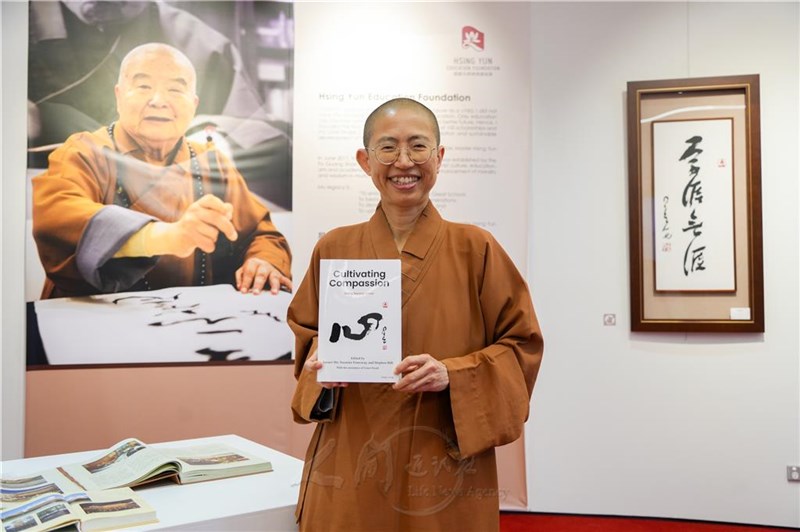
 Venerable Juewei says that this book is dedicated to Venerable Master Hsing Yun, the founder of the Humanistic Buddhism Symposium. photo/The Life News Agency
Sioh Yang Tan
December 27, 2023
Fo Guang Shan Institute of Humanistic Buddhism (IHB) and Humanistic Buddhism Centre of Nan Tien Institute co-launched a new book, "Cultivating Compassion: The Power to Transform Crisis” at the 10th Symposium on Humanistic Buddhism held at Fo Guang Shan on 16th December 2023. A collection of proceedings from the 8th Symposium on Humanistic Buddhism held in 2021, the book featured 17 papers contributed by a multidisciplinary, international, and intergenerational group of authors from 8 countries including Buddhologists, sociologists, First Nations writers, practitioners and students. The ceremony was witnessed by an audience of more than 200, including Venerable Miao Fan, Chancellor of IHB, Emeritus Professor Stephen Hill from the University of Wollongong, Venerable Dr Juewei, Director of the Humanistic Buddhism Centre, Nan Tien Institute, Professor Bee Scherer, Rector of the Buddhist Seminary at Vrije Universiteit Amsterdam (VU) Amsterdam, and Dr Cecile Manikan, Director of the Humanistic Buddhism Research Center of the Philippines. Ven. Miao Guang, Deputy Chancellor of IHB, was the facilitator. 200 copies of the book were released on the day of the launch.
 Fo Guang Shan Institute of Humanistic Buddhism (IHB) and Humanistic Buddhism Centre of Nan Tien Institute co-launch a new book, "Cultivating Compassion: The Power to Transform Crisis.” photo/The Life News Agency
Venerable Miao Fan was delighted with the publication of the book, a fruition from the first and only online symposium of the series. Responding to the theme of the book, she said that external crises come from greed, anger, ignorance and attachment in our hearts. All these defilements can be transformed by practicing the Three Acts of Goodness. She hoped that exchanges and learnings at the symposium will activate the power of compassion, paving the path for the liberation of all sentient beings.
 Venerable Miao Fan is delighted with the publication of the book. photo/The Life News Agency
This book was divided into three parts. The first part presents a Buddhist Reading of contemporary Crises, the second part discusses ways to enrich and nurture compassion in the face of crises, and the final part showcases different paths of putting compassion into action.
In his introduction to the book, co- editor Professor Stephen Hill said that the papers highlight the critical role of compassion in both theory and practice for humanity. Quoting Most Venerable Abbot Hsin Bau’s foreword that transformation should start from the individual’s mind, Prof Hill emphasized that compassion is critical for the survival of humanity as a mutually supportive whole. Through the book, he hoped to encourage more people to reach out and create communities of unconditional loving kindness in world.
 Professor Stephen Hill says that the papers highlight the critical role of compassion in both theory and practice for humanity. photo/The Life News Agency
Co-editor Venerable Juewei said that this book has achieved several “firsts”: it was the first time that proceedings of the symposium was published by a mainstream academic publisher, the first time for Venerable Master’s one-stroke calligraphy to grace the cover, and the first time diverse voices from an international, inter-generational and multicultural group of authors were featured. Venerable Juewei said that this book is dedicated to Venerable Master Hsing Yun, the founder of the Humanistic Buddhism Symposium. The Venerable Master once said, "The banner of Dharma cannot be toppled, and the lamp of wisdom must not be extinguished." Venerable Juewei hoped that the book would contribute a small part to his wishes in propagating Humanistic Buddhism.
Following the introduction to the book, two contributing authors spoke about their chapters. Starting from the familiar Buddhist vignette “for the benefit of all”, Professor Bee Scherer examined what ultimate altruism mean in relation to Human World Buddhism (Humanistic Buddhism), with the aim to demonstrate how global Buddhist traditions apply altruistic Buddhist practices to the context of contemporary social injustice.
 Professor Bee Scherer examines what ultimate altruism mean in relation to Human World Buddhism. photo/The Life News Agency
“Bayanihan”, a Filipino term that refers to the community spirit where one renders oneself to serve the collective, was the central theme of Dr Cecile Manikan’s paper in the book. She shared the story of a girl who founded a “community pantry” on the streets in a dire attempt to give her all to help her disaster-stricken community. It was a simple idea where people were asked to give what they can and get what they need. The story went viral and community pantries were found all over the Philippines in no time. Cecile used this compelling story to explore the relationship beterrn “bayanihan”, compassion and Humanistic Buddhism.
 Dr Cecile Manikan shares the story of a girl who founded a “community pantry” on the streets in a dire attempt to give her all to help her disaster-stricken community. photo/The Life News Agency
At the launch, Venerable Juewei also spoke about other projects of the Humnanistic Buddhism Centre and invited the audience to participate in the Humanistic Buddhism Special Interest Group and contribute to the journal "Studies in Humanistic Buddhism".
Open access full text of "Cultivating Compassion: The Power to Transform Crisis” is available at: https://www.peterlang.com/document/1340151