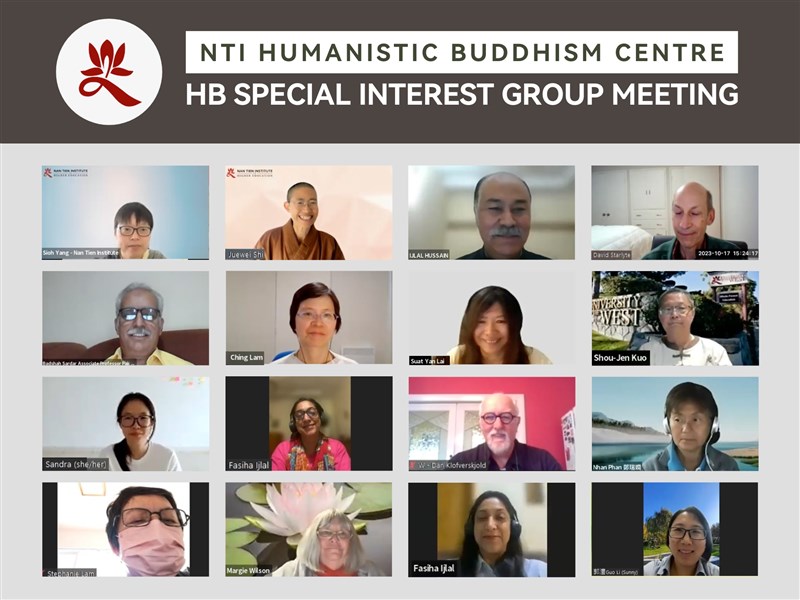
 The Humanistic Buddhism Special Interest Group (SIG) held its third online meeting on October 17. photo/The Life News Agency
Sioh Yang
October 19, 2023
The Humanistic Buddhism Special Interest Group (SIG) held its third online meeting on October 17, which brought together twenty scholars, researchers, and enthusiasts from Australia, Pakistan, New Zealand, Malaysia, China, Hong Kong, the Philippines, and the United States to explore various aspects of Buddhism through a humanistic lens. The meeting featured three speakers who delved into diverse aspects of Buddhism, shedding light on their ongoing research.
Dr. Ijlal Hussain Shah, founder and director of Silk Road Centre, Islamabad, Pakistan, provided the audience with insight into the origin and state of research on the Gilgit Manuscripts. These manuscripts took their name from Gilgit, Pakistan, where they were first discovered in 1931. Four separate excavations, the last made in 1956, uncovered 77 texts in this collection, including sutras, vinayas, avadanas and dharanis from the Buddhist canon.
 Dr. Ijlal Hussain Shah provided the audience with insight into the origin and state of research on the Gilgit Manuscripts. photo/The Life News Agency
He discussed the significance of these ancient texts and the ongoing efforts to decipher and interpret the content.
Dr. Ching Lam from New Zealand spoke on her PhD work, "A Habitus Transformation Model: A Sociological Context for the Buddhist Teachings of Mindfulness Practice and Dependent Origination." Her model is based on the premise that enlightenment and social change cannot be separated and suggests how creating a mindful habitus can be conducive towards creating social change. Dr Lam proposed that mindfulness practice can lead to a realisation of the Buddhist doctrine on dependent origination, which uncovers the invisible fabrics connecting individuals to the world and helps us recognise the root causes of today’s crises.
 Dr. Ching Lam spoke on her PhD work, "A Habitus Transformation Model: A Sociological Context for the Buddhist Teachings of Mindfulness Practice and Dependent Origination." photo/The Life News Agency
Finally, Dr. Suat Yan Lai, Deputy Head of Humanistic Buddhism Research Centre at the University of Malaya explored “The Life and Contributions of Fo Guang Shan Female Monastics at Dong Zen Temple". Dong Zen temple is the headquarters of Fo Guang Shan (FGS) Malaysia at Jenjarom Village. Her work aimed to fill a research gap on FGS female monastics, who have not been described much in academic studies despite their significance in both numbers and contributions. Venerable Master Hsing Yun, founder of FGS, affirmed that equality is “the truth of the universe and the root of Dharma”. He recognised that all beings, male or female, are equal in terms of Buddha Nature. Dr Lai’s research examined the manifestation of these principles in the practices and life stories of monastics at Dong Zen Temple.
 Dr. Suat Yan Lai explored “The Life and Contributions of Fo Guang Shan Female Monastics at Dong Zen Temple." photo/The Life News Agency
Dr Juewei Shi, Director of Humanistic Buddhism Centre at Nan Tien Institute, thanked the presenters and audience for their participation. The October meeting marked the conclusion of the 2023 series of meetings for the group. In 2024, the group will reconvene on March 12.
The Humanistic Buddhism SIG is committed to advancing the understanding of Buddhism and its potential to contribute positively to the modern world. The presentations and discussions left participants with valuable insights and connections, underscoring the importance of continued dialogue and research in Humanistic Buddhism. Those interested in the SIG's activities are welcome to email [email protected] to find out more.