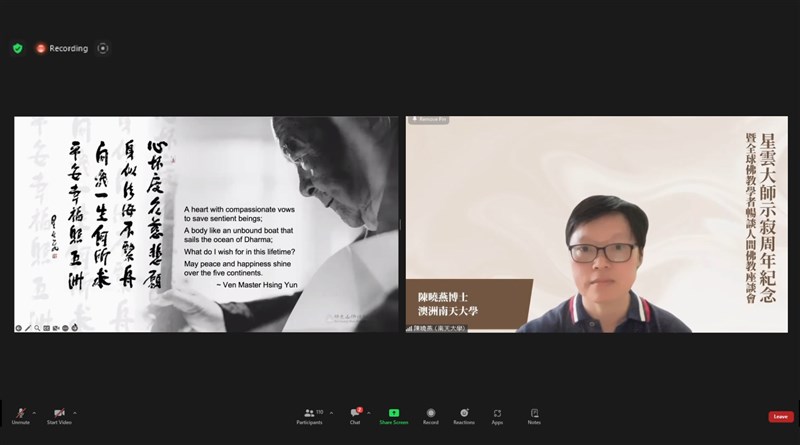
 Dr Juewei Shi and Dr Sioh Yang Tan co-presented a paper at the Global Conference of Buddhist Scholars on Humanistic Buddhism. photo/The Life News Agency
Humanistic Buddhism Centre at Nan Tien Institute
January 23, 2024
On January 19, 2024, Dr Juewei Shi, Director, and Dr Sioh Yang Tan, Research Assistant at the Humanistic Buddhism Centre at Nan Tien Institute, co-presented a paper at the Global Conference of Buddhist Scholars on Humanistic Buddhism. The two-day conference was held to commemorate the one-year anniversary of Venerable Master Hsing Yun’s passing and was co-organised by the Centre for the Study of Humanistic Buddhism at Chinese University of Hong Kong, Centre of Buddhist Studies at Peking University, Institute of Buddhism and Theory of Religion at Renmin University of China and Fo Guang Shan Institute of Humanistic Buddhism.
The paper delved into the profound legacy of Venerable Master Hsing Yun and his vision behind the global temple-building project undertaken by Fo Guang Shan. Venerable Master Hsing Yun (1927-2023), a beacon of compassion and wisdom, left a lasting impact on Buddhism by establishing a global network of temples. The paper focused on the period between 1978 and the 2000s when Fo Guang Shan embarked on a global campaign to build temples outside Asia.
The authors explored the temple-building project through the lens of "delivering the multitude" (度眾 dù zhòng). In Chinese Mahayana Buddhism this expression signifies the liberation of sentient beings from sufferings, aiming to bring peace and happiness to people across the world. True to the spirit of a Bodhisattva, the Venerable Master emphasized that “delivering the multitude” should be placed before the personal goal of transcendence.
The paper explored the shared features of major Fo Guang Shan temples, emphasizing the principles of Humanistic Buddhism embedded in their construction. It examined how temple-building was undertaken to deliver the multitude by making the Three Jewels of Buddhism, the Buddha, Dharma and Sangha, accessible to as many people as possible.
"The Complete Works of Venerable Master Hsing Yun" provided valuable insights into his intentions behind building temples. He envisioned these places as more than traditional centers of worship, viewing them as spiritual gas stations and "department stores for spirituality." Fo Guang Shan temples offer diverse practices, including meditation, chanting, tai-chi, and art, catering to the varied spiritual needs of individuals.
Furthermore, the temples serve as bases for promoting Humanistic Buddhism through cultural, educational, and charitable activities. Charity, in the context of Fo Guang Shan temples, extends beyond disaster relief, providing solace to those in need and alleviating spiritual suffering.
Accessibility and multifunctionality are key principles in the design of the temples at Fo Guang Shan, ensuring they are welcoming and open to a diverse audience. The Venerable Master personally oversaw many of these construction projects, emphasizing details like accessible restrooms and open spaces. The authors cited storied told by his disciples to illustrate how the Venerable Master exercised compassionate skilful means to bring the Buddha’s teachings to the world through building temples.
The paper also highlighted Fo Guang Shan 's commitment to involving local communities in the temple-building process, fostering a sense of belonging and unity. The temples, guided by Venerable Master Hsing Yun's wisdom, continue to aspire to be places of education, open communication, and communal support.
The paper was part of a hybrid bilingual session attended by more than 100 participants in-person and online. Apart from the paper from the Humanistic Buddhism Centre of Nan Tien Institute, scholars from Pingtung University in Taiwan, Dongguk University in South Korea, Cambridge University in the United Kingdom and Florida Atlantic University in the United States also presented in this session.